Featured

Preparing for a hospital stay

Being admitted into hospital is a challenging time. When it is a planned admission, there is time to plan and organize oneself, taking time to decide what to take. This planning can prove valuable in helping us distract ourselves and not dwell too much on the upcoming ordeal. It can also be a source of stress as we ponder what we’ll need in what is usually an unknown environment. 

Do I need towels or are they provided? How many of my own clothes do I need? How much space is there to keep everything? How secure is it? How will I keep myself occupied? What books, magazines or technology can I take? 

Having spent time in this environment, some of the things that people have found invaluable are:

  1. Eye masks – hospitals are noisy, busy and lit up places. Even with the best will in the world, keeping lights low and noise down consistently can be a challenge. Overhead lights are bright, and when the nurses and doctors are working by the bedside, will have those on. It is ‘s very distracting to have bright lights in our faces, especially when we are tired or trying to sleep. Even when we are just resting, it can be irritating. Eye masks can provide the respite we need and allow us to rest in relative peace. There are so many to choose from and the best one for us will come down to preference. 
  2. Ear plugs – For pretty much the same reason as eye masks, ear plugs are very useful when we are faced with noises in the ward. Many of the machines used in hospital beep. This is important in alerting the team that the machine needs attention, and is therefore vital. Until such a time as we find a way to do this alerts quietly, mitigating for this falls on the patient. Again, like with eye masks, there are a variety of ear plugs out there and it really depends on what works for us. Some people do struggle to wear ear plugs, and they either have to brave the noise, or try headphones. 
  3. Headphones – headphones1 are a great piece of equipment to bring to hospital for various reasons, and they do not take up too much space. We can use them to block out excess noise, same as ear plugs. They are also very good for allowing us to listen to music, podcasts, audiobooks, watch films and shows. Having access to these activities will help us stay occupied and distract ourselves. Time can seem to stretch impossibly ahead of us. Boredom, discomfort or even pain can make our stay hard, and having access to things that are meaningful to us can be a source of much needed comfort. 
  1. Pen, notebook/journal – doctors, nurses and allied health professionals will do a ward round together. This is where they see each patient and get an update on their progress and review how the treatment is going and decide if any changes are warranted. Often patients will have questions that they need to ask, and it is worth noting this down because it is easy to get distracted when one has several people around the bed talking in what to a lay person sounds like a different language. Writing the questions down before hand means you can then read them without the risk of forgetting. Some people also like to make a note of what the medical team say, and having a pen and paper handy helps with is. These rounds can happen without relatives or friends there, who we may need to update later and writing it down helps to remember, especially as the brain is working incredibly hard to help us get well, is probably loaded with strong medications, and is tired and therefore too much information is easily confusing. 
  2. Reading material – as with music, magazines and books can be a lifeline when we are admitted in hospital. The hours can seem to stretch and the walls to draw in, and there are only so many walks one can do around the ward and the corridors. Soon after an operation or when we are very unwell, the brain can be too tired to focus on heavy reading, but magazines, puzzle books and word searches are light enough for the brain to grasp. 
  3. A little 24hr light up clock. Some wards and room will have clocks but not always. Sleep can be elusive in hospital and when we are tired, in pain or on strong medications, even more so. Days and nights can tend to meld into each other and having a 24 hour clock helps with knowing exactly what time it is. For some people this can be comforting and can help them plan their time. However, some people find that having a clock is counter productive as they spend countless hours watching it and feeling frustrated at how little it’s moving …it seems to be moving backwards! 
  4. A night/dressing gown/housecoat – if one has ever been in admitted in hospital, they know the indignity of feeling bare backed and unable to get the flaps to overlap appropriately. Hospital gowns are designed to come off easily. A personal gown, especially when we are walking around can be very handy in helping us focus on walking and not on whether our dignity is intact when we are unsteady on our feet. 
  5. Change of clothes – when we are able, getting dressed in our own clothes is probably one of the best things we can do for our well being. Staying in hospital gowns or night clothes have the inadvertent effect of making us feel like invalids and even though that is what we are, getting dressed could help us feel more like our well selves. A very small fleece blanket can be handy for wrapping around us or on our bed for extra warmth and comfort, though this might not always be possible due to infection control considerations.
  6. Mobile phones, tablets, laptops – are all good for staying in touch with loved ones and watching our favorite shows. 
  7. Photos of loved ones, places we love, pets. Especially for longer stays, having a visual reminder of people we care about, or places and times when we have been well can give us sense of hopefulness, and motivation. Of course this can do the opposite and prove demotivating and depressing. Often people will say they have millions of pictures on their phones, but when one is tired or heavily medicated, scrolling on the phone can feel like too much work.

Some links on the page are affiliate links. I may get some compensation if you buy through them.
Broken: the pain of separation

Featured

When we get separated from our loved ones, whatever the reason, we can be engulfed by emotions that are so diverse and varying in the depth of impact that we are often not able to tease out what exactly we are feeling. If there is anything that the years of covid and the accompanying lockdowns brough to sharp focus, it is the isolation that can come from separation. When I think about the many instances in which we are separated from loved ones, I cannot help but think that we have often under-estimated the impact that has had on us. Or perhaps it was the length or the scale and the forced-ness of the lockdowns, coupled with the fear for our health and our lives that made it that much more felt.

Separation comes in many forms and as a result of varied reasons. When I have spoken to people who have been separated from their loved ones, either geographically or emotionally, the sense of loss, which undulates at different times, is palpable. Often people move away because they have some sort of choice and can always go back. They move because it feels like a natural progression and even though painful, it was always coming and somewhat planned for. There can be enough novelty in the move to keep them intrigued, and as they wrangle with the rigours of settling in, the pain of homesickness is somewhat diminished. As someone who moved away, even in the pain of my own loneliness and sense of loss, I often wondered about the pain for those that I left behind. How they filled the gap that I left, if ever they did. 

For those who moved away of no choice of theirs, I can but only begin to imagine what a traumatic experience that is. Driven out by violence, poverty or disaster, irreconcilable differences, leaving behind all they had and all they knew, into a world that is often just as unforgiving, alien, unwelcoming and even hostile. How bewildering an experience that must surely be. 

For many, missing out on the day-to-day happenings in the lives of their loved ones is painful. For others, it is the big events: births, marriages, illness, that hurt the most. It is the act of communal sharing that is missed. Of being with kin. Of belonging. Sometimes, it is the burden of not being close enough to help that can feel so overwhelming. When parents are ageing and in need of care, we can be full of guilt when we are too far to provide any. If there are siblings that are close enough to take on that role, we are troubled by the fact that they are taking on all the responsibility. This can be made even more complex when we have to make financial and other decisions from a distance. Faced with so much out of our control we can be left feeling helpless, alone and separate.

Death is of course the ultimate separator and when this occurs at distance, it can be especially painful. There is something about being close enough to say goodbye that is both terrible and simultaneously comforting for the dying and the ones being left behind. To hold the hand of a loved one, read them their favourite story, listen to their favourite music, recall a moment in time, or simply say nothing can be a gift. And to miss that opportunity, soul destroying.  

If we come from communities where grieving is overtly communal, being far away can be a lonely and painful journey, both in reality and figuratively. Memories are usually fragmented as we desperately try to piece together the last time we spent in each other’s company.  As we grasp at anything that will help us bridge that distance. Sharing with others and talking about the departed loved one is part of the process of making sense of what has happened. When that is missing, we lose a vital part of our grieving ritual. A lot can be said for social media but one of the things it has done is bring us closer, wherever we are in the world and allow us to partake in the ceremonies, rituals, companionship that we so need. 

Finding people, things and spaces that can help us make sense of our loss is vital, not just in dealing with it in the now, but in helping us adjust, move towards acceptance and forge a future that is fulfilling. Books and music are some ways we can ameliorate our sadness. Sometimes we will seek what is familiar, and at others will look for activities that are far removed: it really depends on what resonates with us in that time. I have found self compassion and understanding, honouring how I am feeling at any given time, without judgement, so very helpful.  Even when I howled with indescribable pain underneath the covers, or when I had to soothe myself because I felt that if I started crying, if I gave in to my despair I would never stop, or when I was so numb I felt nothing. In all those times, I hang on to the fact that those were all valid expressions of the love I had, still, for those I missed.

It is near on impossible, during the throws of loss, to ever think that anything positive would come out of it. Indeed, I believe it can be emotionally damaging to try and paint a positive picture of what is a horrendous experience. What we can get out of it with time, is a sense that we can get through challenges and an acknowledgment of the resilience and strength developed through these experiences. I have known people take up new hobbies; swimming the channel, hiking and trekking, volunteering, all things they thought they were incapable of doing.

Frames of reference

Featured

In recent years, crime programmes have made the actions of people who commit major and often horrific offences more accessible viewing. In the past, we read about these happenings in newspapers, there were snippets on TV and the odd documentary. Through in depth interrogations and gavel to gavel coverage of court proceedings, we are exposed to the accused’s belief systems, ideologies, perspectives and mindsets. Their frames of reference. Looking at the number of views on said programmes, in their hundreds of thousands if not millions, one cannot help but wonder at our interest in what is often disturbing and painful viewing. I have often wondered why we are seemingly fascinated by them. I have certainly asked that question of myself many times. and perhaps it is driven by a curiosity into the minds of people who we see as having very different frames of reference to ourselves.

Comments under these videos express horror, shock, disbelief, a castigation for the accused and empathy for victims. Perhaps our curiosity is based on a need to see the opposite of who we think we are. Perhaps there is an evolutionary basis for our protection; if we know these people exist, then we can better protect ourselves. Their actions are so far removed from how we see ourselves and the world that we cannot help but want a peek into their minds. Wanting to see the people behind the crimes and their punishment is not a new phenomenon. We know that in many communities, punishment for similar crimes was communal and open: in the middle of town squares in medieval England, around a council of elders in African indigenous communities, and on the tops of hills in others. Jesus, according to the bible was crucified with two criminals on top of a hill, after much public clamouring in front of Pilate’s court.

While these people may have a very different way of looking at things, and are at one extreme end of the spectrum, the way we see the world – our perspective or frame of reference – very much influences how we behave and is closely linked to our identity. It provides a stable structure from where we can base our decisions and make choices, and it drives our behaviours. Imagine having to make decisions when we do not know what values or belief we are basing them on. It would be an eternally frustrating battle. Having a certain frame through which we see the world thus allows us to interact, build or break away from relationships, make decisions on careers, parenting, finances, look after our physical, mental and emotional health and so on.

From this, it is easy to see how our lives are influenced by this structure and by extension; other people’s lives will be too. If everyone is working from a very unique and personal frame of reference, how can we ever agree on anything? The way we see our world will be influenced by several things: our families and upbringing, the communities in which we grew up in or live, the culture -customs and traditions, religion or lack thereof, the law, education, and personal experiences etc. Thus we will have a collective way of looking at things that filters into and shapes our personal perspectives. This does not mean that we have no control: we know siblings brought up in the same household who have opposite ways of looking at things. Of course children can experience their parents very differently, but on the whole, family systems tend to work on the whole unit. How much these external factors influence us will depend on how much insight and self awareness we develop, how reflective we are, which we can do through Journaling 1, and how willing we are to interrogate our values, beliefs and ideas and then change them. Often, we never stop to think about where the ideas, values and beliefs that we hold on to so tightly came from. We just accept them as is. Next time you have a strong view about something, try and think where that came from: a teacher, a parent, a peer, society. Why do you believe that? What can make this self reflection even more complex is when we have a frame of reference, taken on from others that we ought to just accept things as they are, and we must not question.

If our perspectives influence the way we behave, then we can extrapolate from this that if we understand the perspectives of others then we can better interact with and or support them. One area that we can use frames of reference to guide us is in our relationships. If someone’s frame of reference is so far removed from ours that we struggle to understand them, then it is going to prove quite challenging to be in say, an intimate relationship with them. This can help us in choosing our partners because once the flush of physical and sexual attraction wanes, the fundamentals: values, beliefs, ideas will remain, and that is what will drive both our behaviours. Are your perspectives so different that they are seemingly incompatible? How do you view money? Parenting? Religion? Politics – especially now when this is getting more and more polarised? Faithfulness, generosity, kindness, boundaries, selfcare, greed, self-centredness, love, independence, expressiveness etc? How fixed are those values and beliefs? Can you be flexible around them? If you have opposing values and beliefs on those very important things to a potential partner or friend, are they a deal breaker for you? How can you work around them?

The same applies to our colleagues and peers, even family members whose perspectives are very different to ours. If we can understand them, we might be able to build better relationships with them. We tend to have less choice about who we work with, unless we move jobs and try and find people with perspectives similar to ours, but that is not always possible. So how can we be more understanding? By listening – really listening, being empathic – seeing the world as if you were them -, trying not judge what they are saying – not being judgemental is not the same as condoning -, seeing them as separate to you: perhaps you would not have done something the way they did, but they are them and you are you. Try to understand why they believe as they do, how did they get there? Being respectful and valuing the other person’s right to hold said perspectives (within the bounds of non-oppressive behaviour).

However, I think the most helpful thing we can do to understand another person’s frame of reference, is learning to understand ourselves, first and foremost.

  1. This is an affiliate link and I might get paid if you buy through it. ↩︎

Of pink petals on orange flowers: whose difference?

I love gardening. I find it therapeutic. I can spend hours in the garden or in the tiny green house at the bottom of our garden. While I will schedule other activities in a bid to make sure they get done, I effortlessly weed, prune or plant and get completely immersed. It’s also a time for reflection for me.

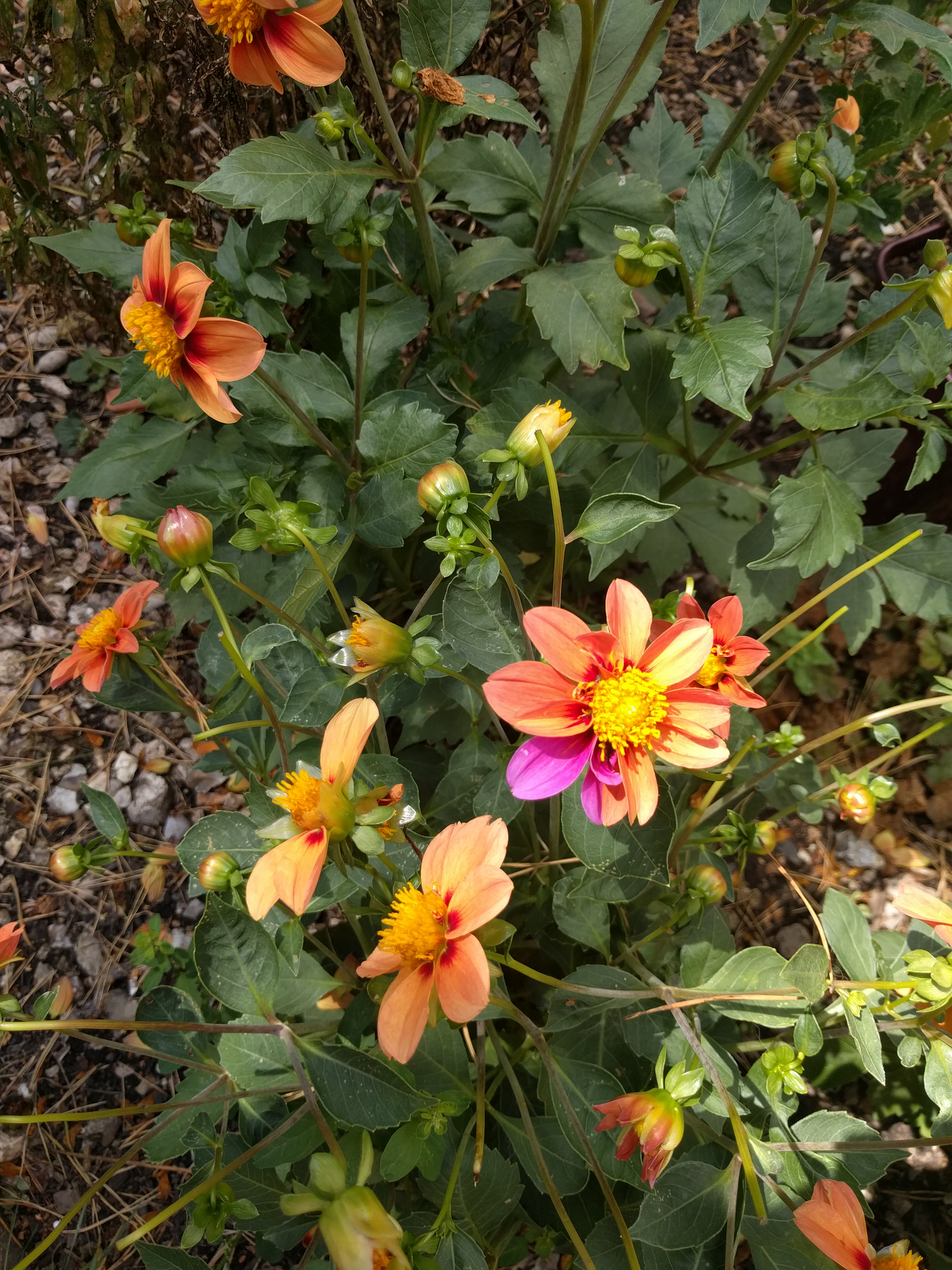
The other day, I saw this flower.

And I couldn’t help but stop and marvel at it. On a bright orange flower, some petals had decided to stand out. The pink was such a contrast to the orange. I checked the rest of the plant, wondering if there were any more like it. It was the only one.

It got me thinking about how we can sometimes struggle with difference. I would think that society plays a role in how we view and identify ourselves and those around us.

That our socialisation can make us somehow wary if not downright hostile to those we perceive as different, as threatening to us as individuals or our cohesiveness, real or imagined.

Those pink petals, standing out as they were, made me pause and reflect. There they were, as much a part of that dahlia as the orange ones. They simply were. They belonged to that plant. They were no less and no more a part of it. Just different.

They made me think about the introjected values and subsequent conditions of worth that shape us. “You are only worthy if you are a certain way, achieve certain things.” And we believe these things, both of ourselves and of others. So we conform. Or try to, creating conflict within ourselves. Not because who we are is in any way detrimental to us or society. And in the process, we lose that which makes us who we are. That which makes us special, unique.

I can search and reflect on the values that I hold, to find where they come from and why I hold them. To see if they truly represent me. And find a way to move closer to my organismic experiencing, my core, which I truly believe, as Carl Rogers said, grows towards that which is gainful not just for me as an individual, but for society as a whole. In so doing, I will set myself free. And I will also let others be.

Because I will be as close to being me as I can be, there will be no defenses. And I will not feel threatened by who others feel they are, I can accept them and value them.